
Regulations
What Is a Digital Product Passport (DPP)? A Guide for Manufacturers Exporting to the EU
What is the Digital Product Passport, which products will need one and when? The DPP, EPD and LCA connection explained through a verifier's lens — for manufacturers exporting to the EU.

İpek Göktaş Kalkan
31 July 2026 · 7 min read
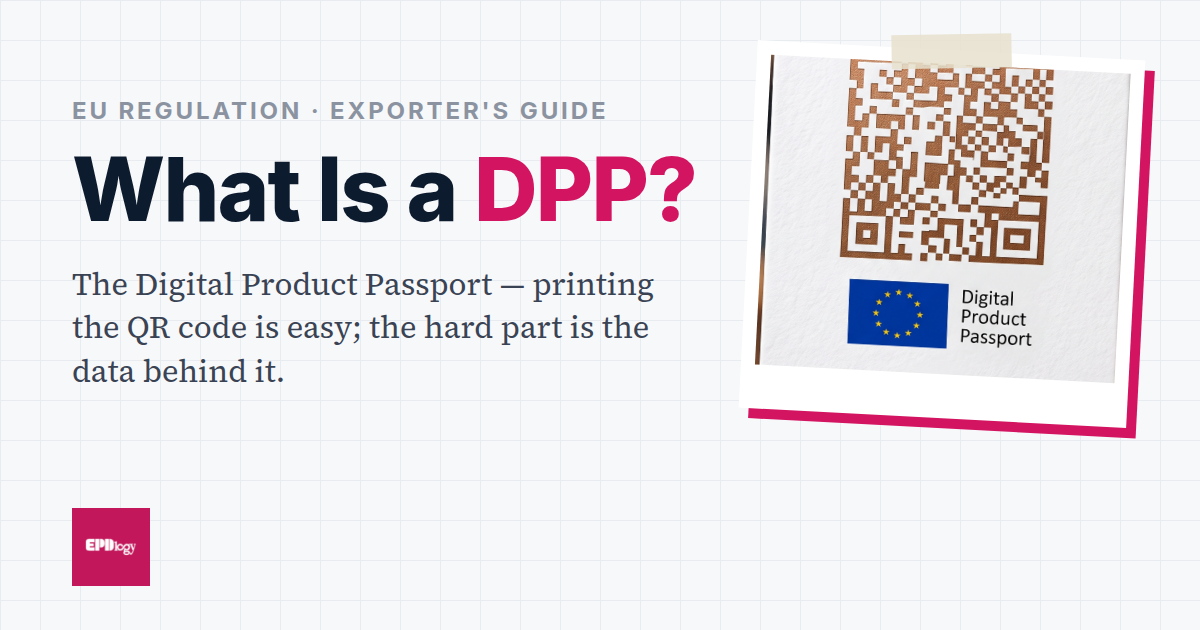
If you manufacture products for the European Union market, within the next few years your products will need to carry a digital identity alongside them. It is called the Digital Product Passport (DPP) — and for many exporters, it is set to become the biggest EU compliance topic after CBAM.
I am writing this as an EPD verifier, because there is a point that keeps getting lost in DPP discussions: the passport is not a technology problem, it is a data problem. Printing a QR code is easy. The hard part is making sure the environmental data behind that code is accurate, traceable and defensible. And that leads straight into the world of LCA and EPDs.
What exactly is a Digital Product Passport?
A DPP makes a product’s life-cycle information — what it is made of, where the materials came from, its environmental impacts, how it can be repaired and recycled — accessible through a data carrier on the product itself, usually a QR code. Buyers, consumers, recyclers and customs authorities will all look at the same passport to see the product’s identity.
Its legal basis is the EU Ecodesign for Sustainable Products Regulation (ESPR), in force since July 2024. ESPR is a framework regulation: which product group needs a passport, from what date, and with which data fields is decided per product group through secondary legislation (delegated acts).
I first heard about the DPP at a meeting EPD International organised for verifiers, where it was discussed that EPDs — and the verified life-cycle data and calculation methodologies behind them — could feed the future DPP infrastructure. Since then I have seen the topic appear more and more on LinkedIn. But working mostly with Turkish manufacturers, my observation is this: a significant share of them still know very little about the DPP — to date, not a single client has asked me about it directly. That is partly why this article exists.
Which products, and when?
The first ESPR Working Plan (2025–2030), published in April 2025, set out the priority product groups and an indicative timeline for when the European Commission aims to adopt product-specific rules: iron and steel in 2026, textiles and aluminium in 2027, furniture in 2028 and mattresses in 2029. Horizontal requirements on recycled content and recyclability for electrical and electronic products are also planned for 2029, with energy-related products handled on separate schedules across 2026–2030.
These are not the dates when DPP obligations actually start, though. For each product group, the delegated act will first define which ecodesign requirements apply and — if a DPP is required — its scope and data fields. Under ESPR, application dates can be no earlier than 18 months after the delegated act enters into force, apart from specifically justified exceptions.
On the infrastructure side, a milestone has already arrived: the EU DPP Registry went live on 20 July 2026. A point that is often misunderstood: the Registry is not a database where product information is stored — it is a central index holding each passport’s identifier and web address. The actual data behind your product’s QR code — material composition, environmental impacts, circularity information — will sit not in the Registry but with the manufacturer or its service provider. In other words, the EU has built the passport’s skeleton; the responsibility for the data that fills it stays with the manufacturer. Which, institutionally, confirms the core argument of this article.
There is also a separate track: the battery passport. Under the EU Battery Regulation, a battery passport becomes mandatory from 18 February 2027 for electric vehicle batteries, light means of transport batteries and industrial batteries above 2 kWh. It will be one of the first real-world tests of how digital product passports work in practice.
Why it already matters for exporters
The backbone of Türkiye’s exports to the EU is exactly the first wave: steel, textiles and apparel, furniture. Home appliances follow their own timeline under the energy-related products track. Once the DPP applies, these products will not enter the EU market without a passport — a market-access condition, much like CE marking.
In my experience there are two kinds of companies in every EU regulation cycle: those scrambling to collect data in the final six months, and those who built their product data systematically two years in advance. We all saw it during the CBAM transitional period. The DPP will be the same film again — except the data set it asks for is much wider.
Last year, in a CBAM project in the aluminium sector, we started very close to the reporting deadline. Time was tight, and the emission data we needed from raw-material suppliers could not be obtained in time, so we had to fall back on default values. The last-minute data collection was stressful for the company and for us — and using default values instead of real supplier data meant the calculated embedded emissions may well have come out higher than reality. That experience showed very clearly why the data infrastructure has to be built before the legislation bites.
The DPP–EPD–LCA connection: this is the real story
Much of the environmental information a DPP will ask for — carbon footprint, resource use, recycled content, durability and circularity indicators — comes from a familiar place: life cycle assessment (LCA). The data infrastructure you build today to prepare an EPD is tomorrow’s core DPP data.
Let me put it the other way around, because as a verifier this is the angle I see most clearly: an LCA built on weak data will no longer be just a verification problem in the DPP era — it will be a market access problem. Today, a gap in production data raises questions during EPD verification; tomorrow, the same gap can meet you at EU customs as a product with an incomplete passport.
Manufacturers who already hold a valid EPD start closest to the DPP: the product system is defined, production data collected, background datasets chosen, results independently verified. What is usually missing is only the digital layer that carries the data into passport format — and if the data is sound, that is the easy part.
What to do now: not panic, but sequence
Check where your product group sits in the timeline. In steel or textiles, you have less time than you think; in furniture, a little more breathing room. Then answer one question honestly: would your products’ life-cycle data pass an independent verification today? If the answer is “not sure”, your starting point is not buying DPP software — it is building your data inventory.
Concrete first steps: document the material composition and supply chain of each product, make your production data (energy, raw materials, waste) routinely collectable, run an LCA for your priority products, and where possible publish and verify it as an EPD. These four steps lay the same foundation for CBAM, for the DPP and for your customers’ supply-chain requests — instead of opening three separate projects for three regulations. Our guide to the EPD process for manufacturers in Türkiye covers this in more detail.
At EPDlogy, when we carry out an LCA for your products we go through your energy, raw material, waste and supplier data line by line and apply appropriate allocation methods for your product groups and production processes, so each product’s life-cycle results and carbon footprint come out separately. The data infrastructure this creates is a strong starting point not only for an EPD, but for CBAM and future DPP requirements as well.
We cannot independently verify a study we have prepared ourselves; but our verifier’s perspective lets us prepare the file for third-party verification, spot likely data gaps in advance and help the verification run more smoothly. Independently verified studies strengthen the credibility of environmental claims — and are increasingly preferred or required in customer requests, tenders, certification and reporting. If you would like to talk through where to start for your products, get in touch.