
LCA
Allocation in LCA: The ISO 14044 Hierarchy and the Question Verifiers Ask Most
If one kiln makes two products, which share of the fuel belongs to which? ISO 14044 answers not with a menu but with an order that cannot be skipped: avoid first, then physical relationship, then other relationships. Why the allocation section comes back most often in verification, and what has to be visible in the report.

İpek Göktaş Kalkan
11 October 2026 · 7 min read
The section we write comments on most often in verification is allocation. The arithmetic is usually right; what is missing is why a rule was chosen and the figures behind it. This article explains the ISO 14044 allocation order, the additional rules EN 15804+A2 brings for construction products, and exactly what a verifier looks for in the allocation section.
Where the problem starts
A line making a single product has no allocation question: all inputs and emissions belong to that product. The question starts when more than one product leaves a process — two board thicknesses from the same kiln, a main product and a by-product from the same reactor, two lines heated by one shared boiler. One electricity bill, two products; which share of the bill goes to which product?
The ISO 14044 order: a hierarchy, not a menu
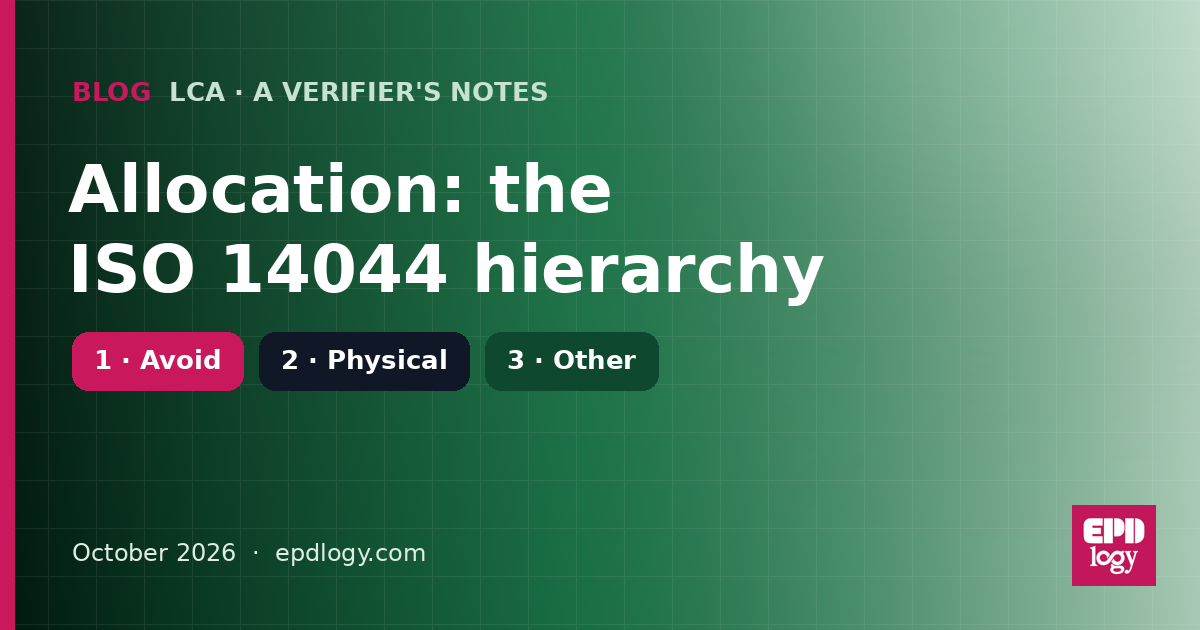
ISO 14044 defines a three-step procedure for allocation. What matters is that it is not a list of options but a hierarchy to be tried in order:
1. Avoid allocation. There are two routes. Subdivide the process into sub-processes and assign each product its own inputs (separate meter, separate recipe, separate line); or expand the system boundary to include the function the co-product displaces. Subdivision is the cleanest route in EPD work and is often possible with one extra meter or production record at the plant.
2. Allocate by physical relationship. If avoidance is not possible, inputs and outputs are shared in a way that reflects the physical relationship between the products: mass, volume, energy content, processing time. The choice of physical quantity is not arbitrary; it should reflect what actually drives the process burden. Sharing a kiln’s fuel by mass is reasonable when both products spend the same time in the kiln; not when one spends twice as long.
3. Allocate by other relationships. If no physical relationship can be established, another relationship such as economic value may be used. This step is not forbidden, but it demands justification: why could the first two steps not be applied? Which period do the prices refer to? How much does the result move when prices change? The last question is answered with a sensitivity analysis.
What EN 15804+A2 adds
For construction product EPDs, EN 15804+A2 sits on top of the ISO 14044 frame and the PCR may narrow it further. The three rules with the most effect in verification:
- Co-product versus waste. A co-product is an output with economic value and takes a share of the process burden; waste takes none. Which class an output falls into changes the EPD result directly — whether a metal slag is treated as a co-product or as waste, for instance, can move the main product’s GWP noticeably. The basis of the classification must be written in the report.
- Method by revenue difference. In joint co-production where the process cannot be subdivided, EN 15804+A2 looks at the revenue difference between the co-products: where it is high (the standard uses a 25% threshold) allocation is by economic value, where it is low by physical relationship. Which case applies must be shown with figures.
- Consistency. The same allocation rule is applied to the same kind of flow across the plant; different rules are not chosen per product.
What a verifier looks for in the allocation section
The sentence “allocation was carried out according to ISO 14044” is not sufficient on its own. The four things we look for:
- A list of every process that requires allocation — which unit process, which products.
- The step applied to each and its justification — avoided (how), physical (which quantity, why), economic (why the earlier steps could not be applied).
- The figures — the allocation ratios and the raw data they were calculated from (production volumes, prices, energy contents).
- Sensitivity — how much the result moves when the allocation ratio changes; especially with economic allocation.
If these four are present, the allocation section closes in one round. If not, every round is a new list of questions and usually means asking the plant for data again — the scenario that extends a project the most.
Practical advice: settle allocation before the calculation
Allocation is decided in the scope phase of an LCA, not in the calculation phase. Before data collection starts, list the multi-product processes at the plant, decide which step can be applied to each, and if subdivision is possible, request the additional records (separate meter, line-level production report) at that point. The “let’s also do allocation now that the calculation is done” approach produces the weakest section of the report.
The scope decisions and four phases of an LCA are covered in the LCA guide, and the terms in the LCA glossary.
Frequently Asked Questions
What is allocation?
Sharing the inputs and outputs of a process that makes more than one product (energy, raw materials, emissions) between those products. ISO 14044 defines an order for it: avoid allocation first, then allocate by physical relationship, and only then by other relationships such as economic value.
Is economic allocation forbidden?
No, but it is not the first option either. Under ISO 14044 it is used only when avoidance and physical relationship cannot be applied; the reason they could not, the price period used and the effect of price fluctuation (through sensitivity analysis) must be in the report.
How does the co-product/waste distinction affect allocation?
A co-product is an output with economic value and takes a share of the process burden; waste takes no share and leaves its own treatment burden with the product. EN 15804+A2 defines this distinction; which class a flow falls into changes the EPD result directly.