
NEWS · 1 September 2026
Will your EPDs need to be verified again? The CPR ties environmental sustainability to AVS 3+
Commission Delegated Regulation (EU) 2026/1310, published on 28 August 2026, says one clear thing in row 10 of Annex II: the environmental sustainability characteristic — for all product families, all categories, all intended uses — is tied to AVS 3+. That means notified-body verification and factory inspection. Whether existing EPDs will be recognised remains unanswered.
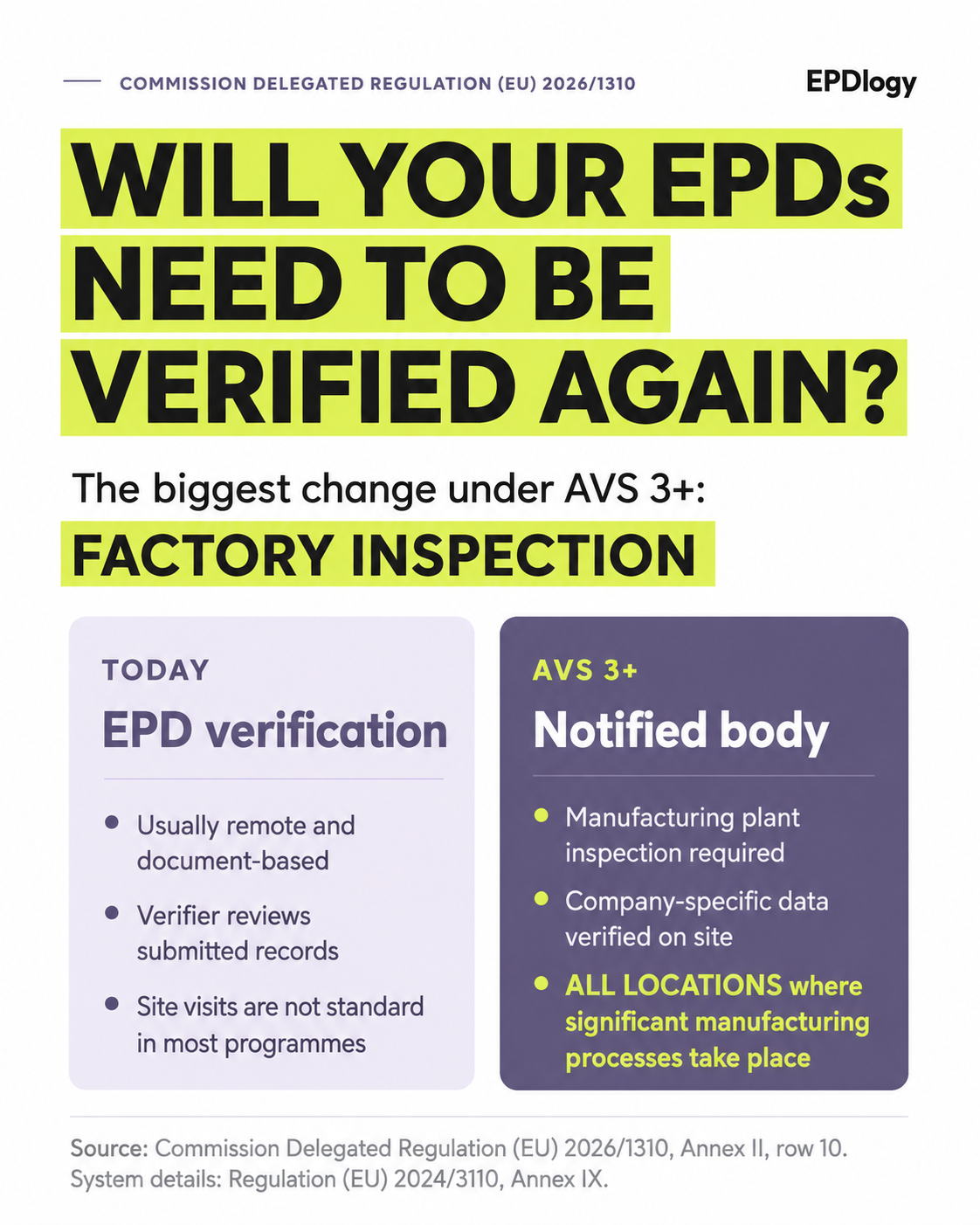
Commission Delegated Regulation (EU) 2026/1310, published in the Official Journal on Friday 28 August 2026, sets out which assessment and verification system (AVS) applies to which product family under the new Construction Products Regulation (Regulation (EU) 2024/3110). Row 10 of Annex II says something that fits in one sentence:
Environmental sustainability → AVS 3+. Product family: all. Product category: all. Intended uses: all. No exceptions.
What does that mean?
Under AVS 3+, environmental performance — the data behind EPDs — must be verified by a notified body. Not an independent verifier approved by your EPD programme operator, but a body formally notified by a Member State.
And the biggest change, one that most summaries barely mention: factory inspection. Under System 3+ as defined in Annex IX of the CPR, the notified body must inspect the manufacturing plant as part of verifying company-specific data — and the inspection must cover all locations where significant manufacturing processes take place. One representative factory is not enough.
Today, most EPD verification runs remotely, on documents: files are submitted, the verifier reviews them, questions are exchanged, revisions are made. A factory visit is not standard practice in most programmes. That is exactly what is about to change — and entering a factory is both more expensive and more time-consuming than reviewing documentation remotely.
The big unanswered question
Will existing, independently verified EPDs be recognised under AVS 3+ — or will manufacturers pay for the same LCA model to be verified a second time? That question has no clear answer yet.
The obligations will not take effect overnight: they arrive product family by product family, as the relevant harmonised technical specifications become applicable (the regulation enters into force 20 days after publication). But the direction is now clear — and the preparation period has already begun.
Our note, through a verifier’s lens: keeping installation data at a “remotely verifiable” standard will no longer be enough; moving now to a structure an auditor can follow on site is the cheapest insurance for this transition.
Download the full text of the regulation here (PDF).
Source: Regulation (EU) 2026/1310, Annex II, row 10; system definitions: Regulation (EU) 2024/3110, Annex IX.